
Online Phonics Classes for Kids in Indonesia
Jolly Reading runs live online phonics classes for children in Indonesia, taught in small groups from India by a certified Jolly Phonics teacher. Children aged 4 to 12 join from home in Jakarta, Surabaya, Bandung, Bali and beyond, read aloud in every session, and start with a free demo class. Classes run on WIB (UTC+7), 1 hour 30 minutes ahead of India-friendly timings.
What to Expect
| Item | Item |
|---|---|
| Method | Jolly Phonics (systematic synthetic phonics) |
| Mode | Live online, small groups |
| Ages | 4–6 (reading foundation) · 6–12 (advanced phonics) |
| Batch size | 5–6 children |
| Class timings | WIB (UTC+7), 1 hour 30 minutes ahead of India |
| Teacher | Megha Vyas, Education Consultant, Jolly Reading |
| Fees | Enquire for current fees |
| First step | Free demo class with a level check |
Why Families in Indonesia Choose Live Online Classes
Specialist centres are concentrated in Jakarta
Families elsewhere in Indonesia have few options within travelling distance.
English exposure varies widely
Children in national schools often meet far less English than those in international schools, and need a method that doesn't assume vocabulary.
Time zones are close
Indonesia is only an hour and a half ahead of India, so evening batches work on both sides.
A 5:00 pm class in India is 6:30 pm in Jakarta.
Phonics in Indonesia: What Parents Should Know
Children here learn English at national schools, at sekolah nasional plus and at international schools following Cambridge or IB programmes, with Bahasa Indonesia usually spoken at home. The gap between English at school and English at home is the main reason reading progress stalls.
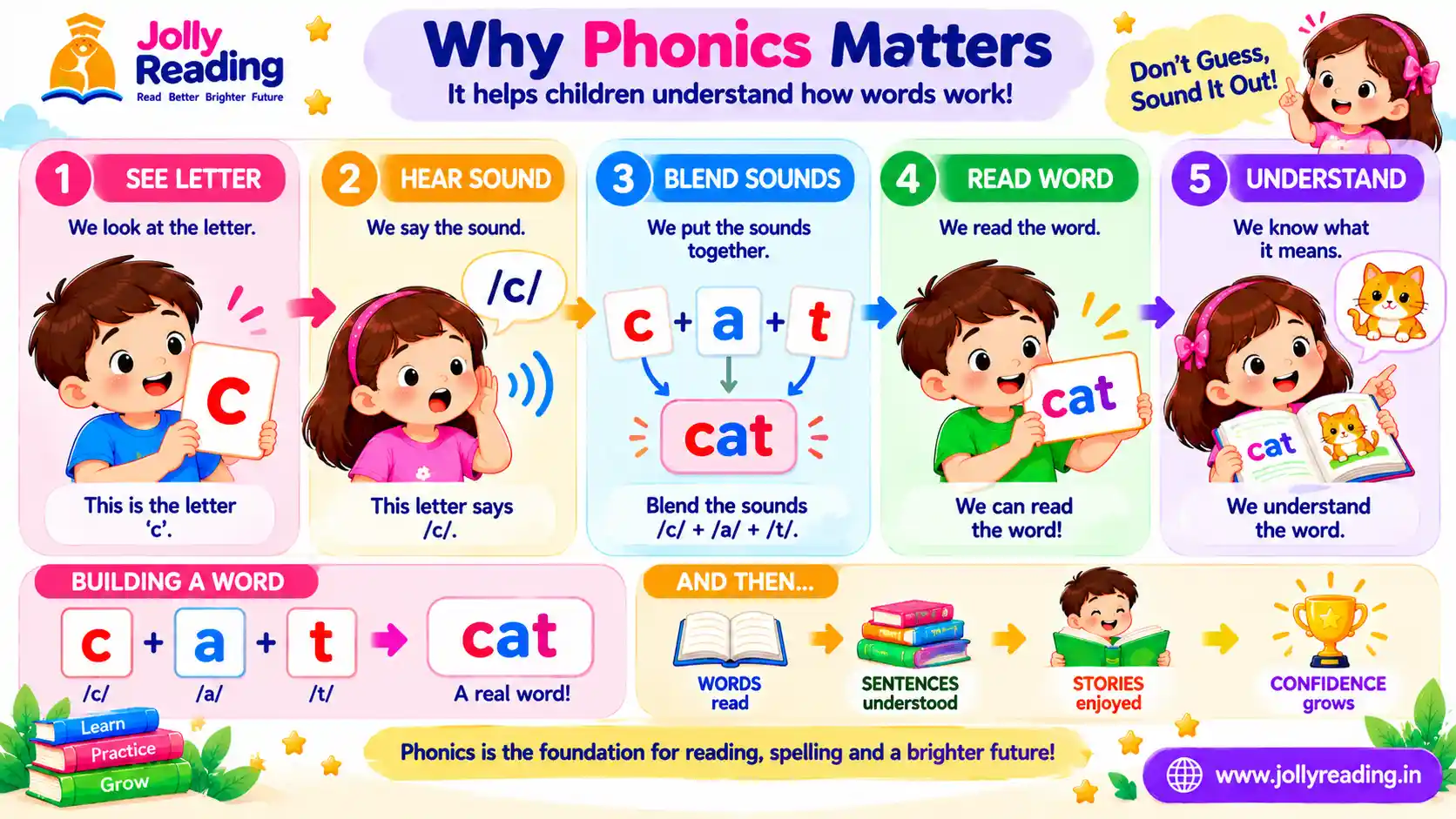
Phonics addresses that directly: a child who knows the sounds can read words they have never heard, and then learn what they mean.
Phonics Across Indonesia's Three Time Zones
Indonesia spans three time zones, and the zone changes how a class fits your child's day. Use this table to convert an Indian class time.
| Where you live | Time zone | Ahead of India | A 5:00 pm class in India is |
|---|---|---|---|
| Jakarta, Bandung, Surabaya, Sumatra | WIB (UTC+7) | 1 hour 30 minutes | 6:30 pm |
| Bali, Lombok, Makassar | WITA (UTC+8) | 2 hours 30 minutes | 7:30 pm |
| Papua, Ambon | WIT (UTC+9) | 3 hours 30 minutes | 8:30 pm |
Families in Bali and eastern Indonesia usually prefer an earlier Indian batch so classes finish before bedtime. Exact batch times are confirmed when you book the demo class.
Has Jolly Phonics been studied in Indonesia?
Yes, in a small way. A 2014 study by Ike Dwiastuti in Jurnal Sains Psikologi, ‘Metode Jolly Phonics sebagai alternatif stimulasi kesiapan membaca anak usia dini’, tested the method with 28 kindergarten children and reported that it effectively stimulated early reading readiness. Another article in an Indonesian education journal looks at teachers' views on using phonics songs in phonics reading classes. These are small studies, so we cite them to show the method is known in Indonesian classrooms, not as a guarantee of results for your child.
Which level fits your child?
| Your child | Where to start |
|---|---|
| Child aged 4–6 starting to read in English | Online Phonics Classes (ages 4–6). Sounds, blending and first spelling. |
| Child in a national or nasional plus school who knows letters but guesses words | Free demo class and level check first; we then place your child in foundation or advanced phonics, whichever fits their gaps. |
| Child aged 7–12 who decodes slowly or spells poorly | Advanced Phonics (ages 6–12). Alternative spellings, syllable types, prefixes and suffixes. |
| You are not sure | Book the free demo class. The level check shows which sounds your child knows and how they decode. |
Sources checked October 2026: Dwiastuti (2014), Jurnal Sains Psikologi · Utilization of Phonics Songs in Phonics Reading Classes in Indonesia (UPI). Listings and fees change, so confirm details with each provider.
Who These Classes Are For
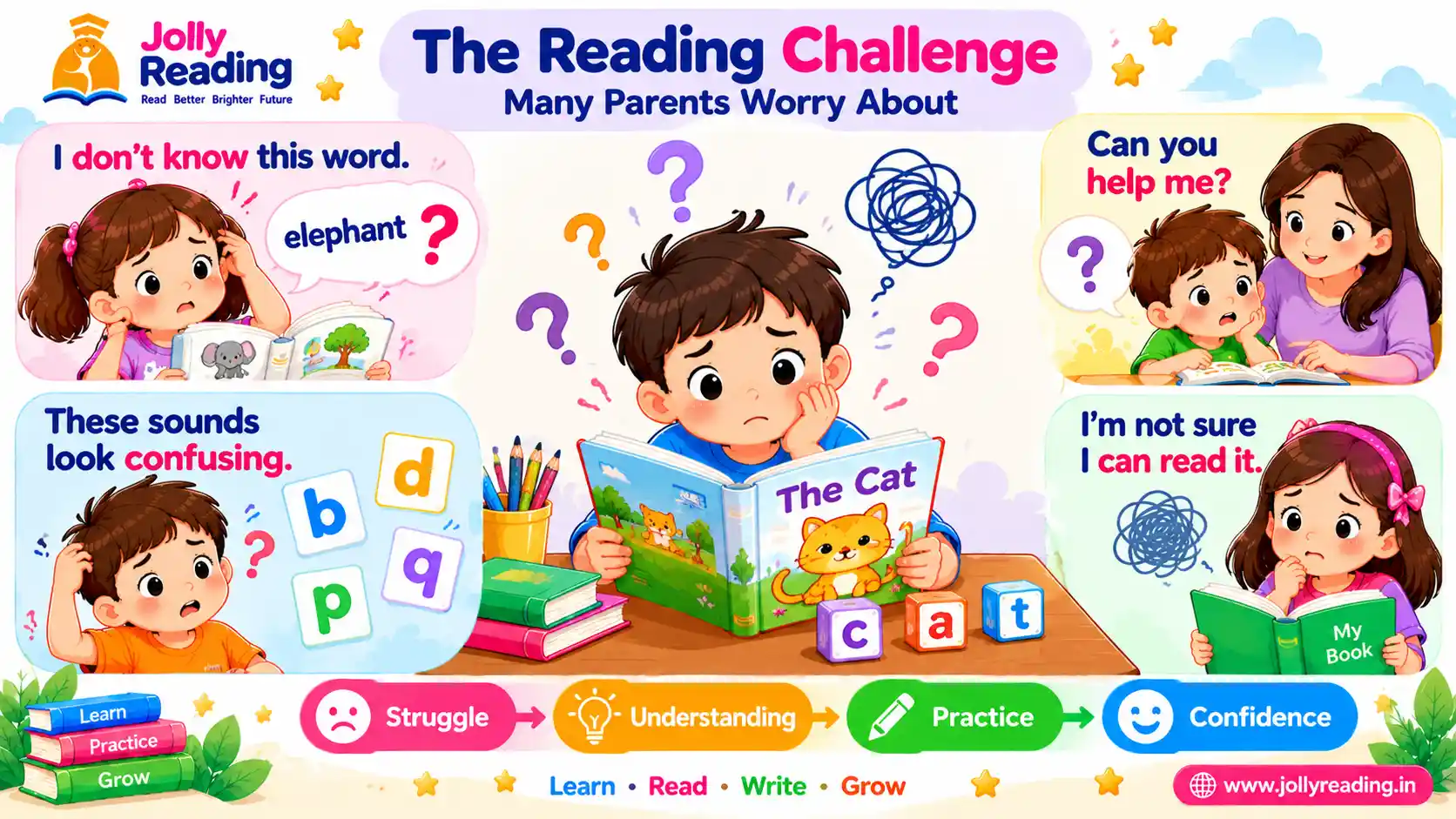
- Children aged 4–6 starting to read in English
- Children in national or nasional plus schools who need more English reading practice
- Families outside Jakarta with no phonics centre nearby
- Children aged 7–12 who decode slowly or spell poorly
What Your Child Learns
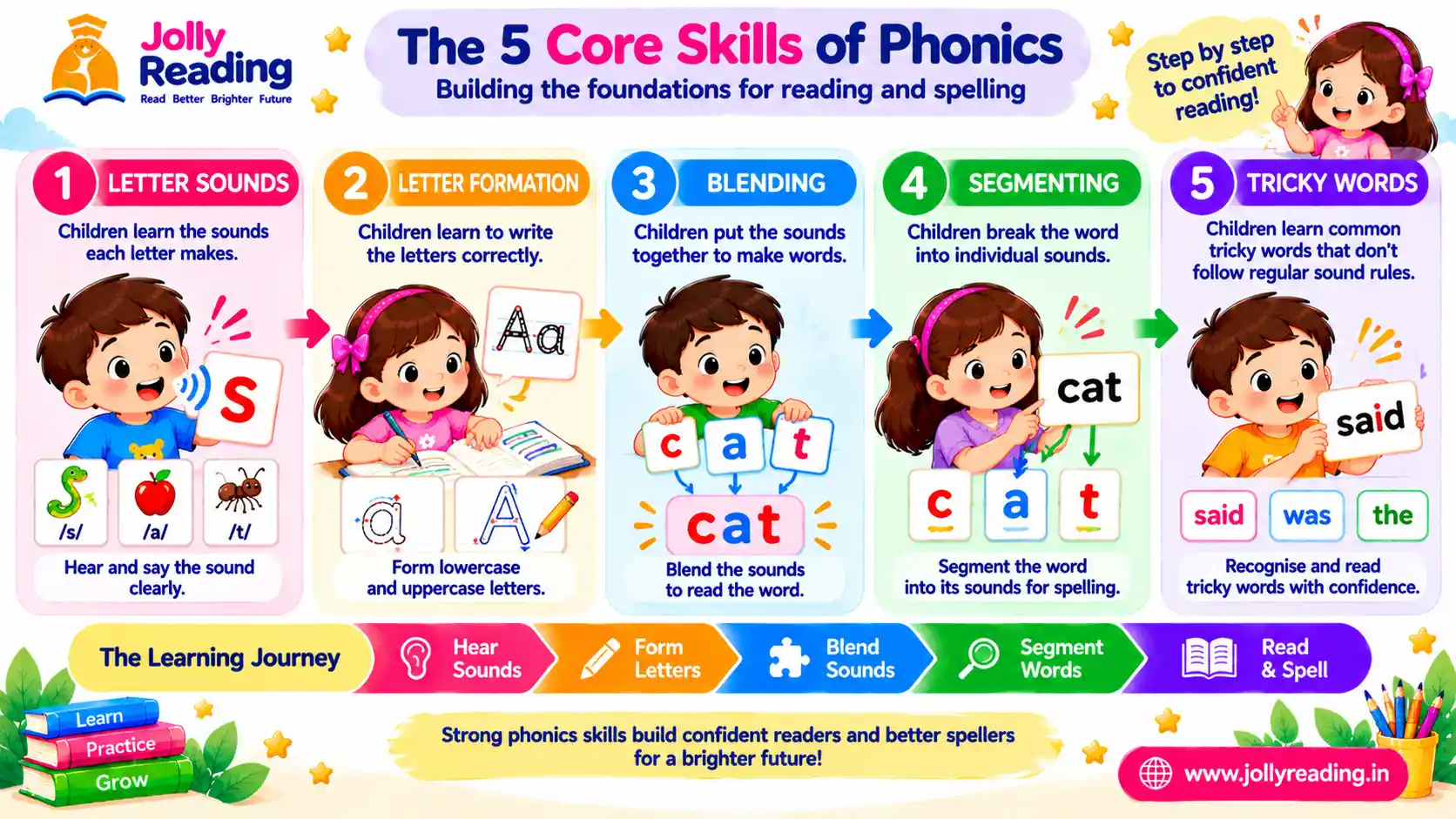
Ages 4–6: reading foundation
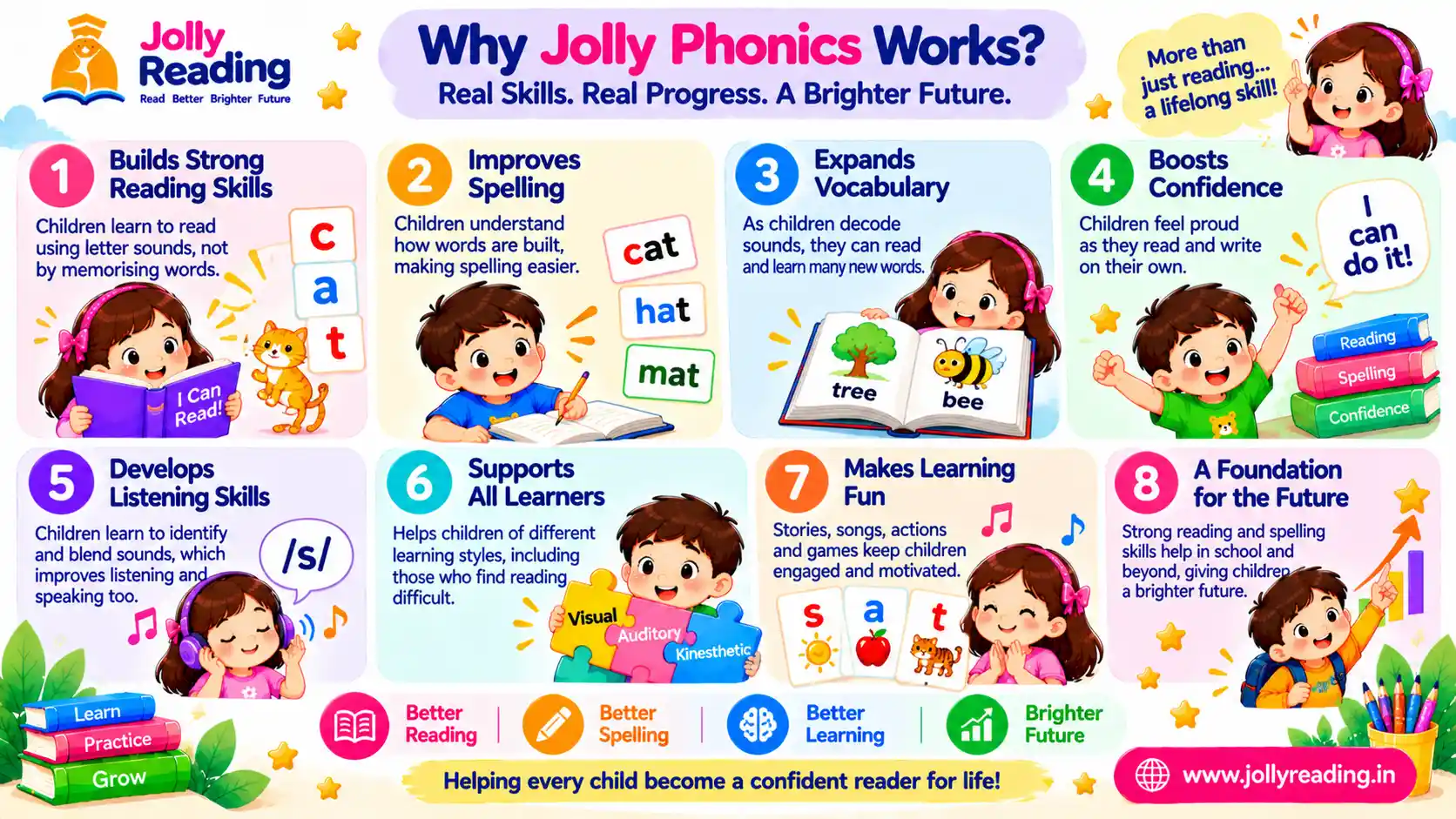
- The 42 sounds of Jolly Phonics with correct pure pronunciation
- Blending sounds to read words, from the first weeks
- Hearing the sounds in words in order to spell them
- Correct letter formation
- Tricky words and reading simple books
Ages 6–12: advanced phonics
For children who read slowly, guess words or spell by memory: alternative spellings, syllable types, prefixes and suffixes, and spelling rules. See advanced phonics.
After phonics
Jolly Grammar: parts of speech, tenses and punctuation, taught with colours and actions.
How Our Online Classes Work
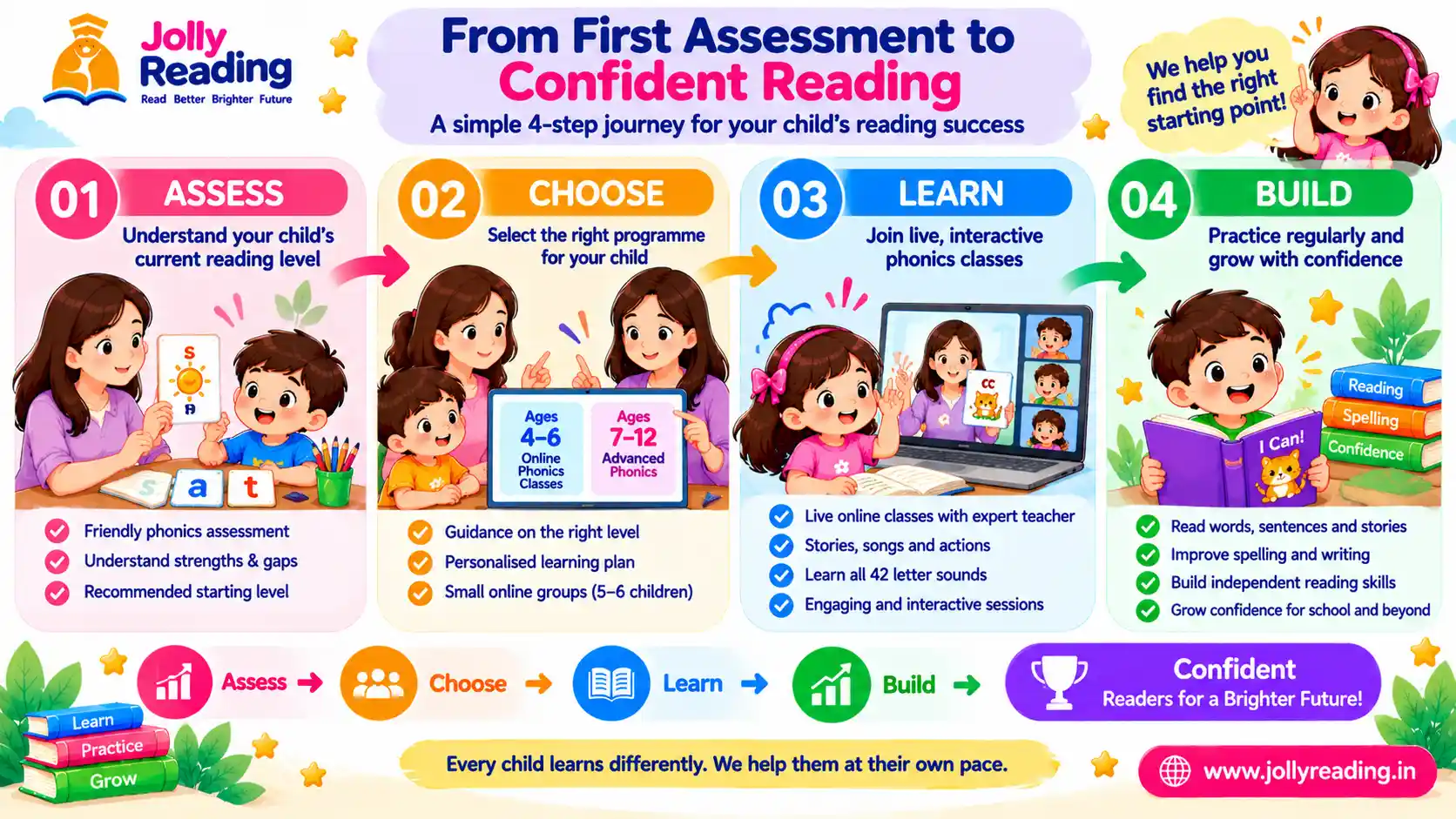
Free demo class
We check which sounds your child knows and how they read, then recommend a level.
Placement in a small batch
at a suitable level and time.
Live sessions
sounds, actions, blending, dictation and reading aloud. Every child gets individual turns.
About 10 minutes of home practice a day
We tell you exactly what to do.
Regular progress updates
from the teacher, so you know exactly how your child is doing
What you need: a laptop or tablet (a phone screen is too small for reading practice), a stable connection, a quiet corner, and a notebook and pencil.
How to Judge Any Phonics Class
Jakarta centres publish class sizes and age ranges, which is good practice. What they can't offer is access for the rest of the country, which is where live online teaching fits. Before you enrol anywhere, ask:
- Does the teacher say pure sounds, /s/ rather than "suh"?
- Does every child read aloud in every session?
- How many children are in the batch?
- Do children blend and read words in the first weeks, or only sing songs?
- Is spelling taught through dictation?
- Who teaches your child, and what is their training?
More on this in our guide to online vs offline phonics classes.
Who You'll Be Trained By
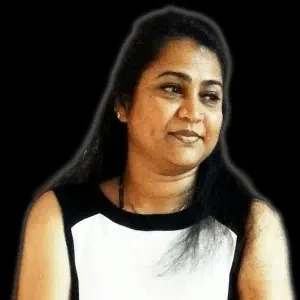
Megha Vyas
Megha Vyas is the founder of Jolly Reading and a passionate literacy educator with over 23 years of experience teaching phonics. She specialises in helping teachers, schools and parents build strong reading foundations through structured phonics instruction.
- Certified in Jolly Phonics & Jolly Grammar through Jolly Phonics CPD College, UK
- Former Air India cabin crew — brings expert pronunciation and phonemic awareness to every session
- Certified Remedial Educator, with hands-on experience supporting children with reading and spelling difficulties
- 2000+ teachers trained across India through structured Jolly Phonics methodology
“To empower learners with the skills, confidence, and proven strategies needed to become successful, lifelong readers.”
Parents Trust Us With Their Children's Reading Journey
“My heartfelt gratitude to you, Megha miss, for imparting quality English language skills to my son Neil. Your method of teaching has ensured he'll never have any problem with English learning in the future.”
“Aarav developed reading fluency and expressive writing skills under her teaching. Megha miss built confidence in him and motivated him for English speaking.”
Book a Free Demo Class
Tell us your child's age and your preferred time in Indonesia, and we will arrange a free demo class.
Teachers and parents in Indonesia who want to teach phonics themselves can also join our Jolly Phonics teacher training course.
Frequently Asked Questions About Phonics Classes in Indonesia
Are there online phonics classes for children in Indonesia? +
Yes. Jolly Reading teaches children across Indonesia live online in small groups, with a free demo class to start.
What time are the classes in Indonesia? +
Classes are scheduled on WIB (UTC+7), 1 hour 30 minutes ahead of India-friendly timings. A 5:00 pm class in India is 6:30 pm in Jakarta.
What age should my child start phonics? +
Most children start between 4 and 5. Older children aged 6 to 12 who read slowly or spell poorly usually start with advanced phonics after a level check.
How many children are in each batch? +
Batches are kept small, 5–6 children, so every child reads aloud and is corrected in each session.
Is online as effective as a local centre? +
For children aged 4 and above, a small live group works well, because the teacher hears and corrects every child. Very young children who cannot yet focus on a screen may do better in person.
Do you follow the Indonesia school curriculum? +
We teach the decoding skills that reading in any curriculum depends on: sounds, blending, spelling and fluency. We are not a school syllabus programme.
What equipment does my child need? +
A laptop or tablet, a stable internet connection, a quiet space, and a notebook and pencil.
Is there a free trial? +
Yes. Every child starts with a free demo class, which includes a level check.
What time are classes in Bali, Makassar or Papua? +
Bali and Makassar use WITA (UTC+8), 2 hours 30 minutes ahead of India, so a 5:00 pm Indian class is 7:30 pm. Papua and Ambon use WIT (UTC+9), 3 hours 30 minutes ahead, so the same class is 8:30 pm. We agree a batch time that suits your zone when you book the demo class.
How much do online phonics classes cost in Indonesia? +
Fees depend on the level and batch, so we share current fees when you enquire. Ask any provider whether the fee covers a live group class or one-to-one tutoring, how many children are in the batch, and how many sessions there are each week.
Is there research on Jolly Phonics in Indonesia? +
There are small Indonesian studies. For example, a 2014 study with 28 kindergarten children reported that the Jolly Phonics method helped stimulate early reading readiness. It is a small sample, so treat it as supporting evidence rather than proof for any one child.