
Advanced Phonics: What It Is and What Children Learn After the Basics
Advanced phonics is what children learn after the 42 basic letter sounds: syllable types, alternative spellings, prefixes and suffixes, and the spelling rules that govern longer words. It is the stage that lets a child read independent or transportation instead of guessing, and spell them without memorising. Children usually need it from around Grade 2 onwards, and older children who read slowly or spell poorly almost always have gaps here.
This guide explains what advanced phonics covers, in what order, and how to tell whether your child needs it.
Basic vs Advanced Phonics
| Item | Basic phonics | Advanced phonics |
|---|---|---|
| Focus | 42 sounds, one spelling each | Many spellings per sound, word structure |
| Words | Short: cat, ship, rain | Long: remarkable, invention |
| Key skills | Blending, segmenting | Syllable division, morphology, spelling rules |
| Typical age | 4–6 | 6–12 |
| Goal | Read simple words and books | Read and spell any word independently |
What Advanced Phonics Covers
1. Alternative spellings
One sound, several spellings: /ai/ as ai, ay or a-e. This is where spelling usually breaks down first. See alternative spellings.
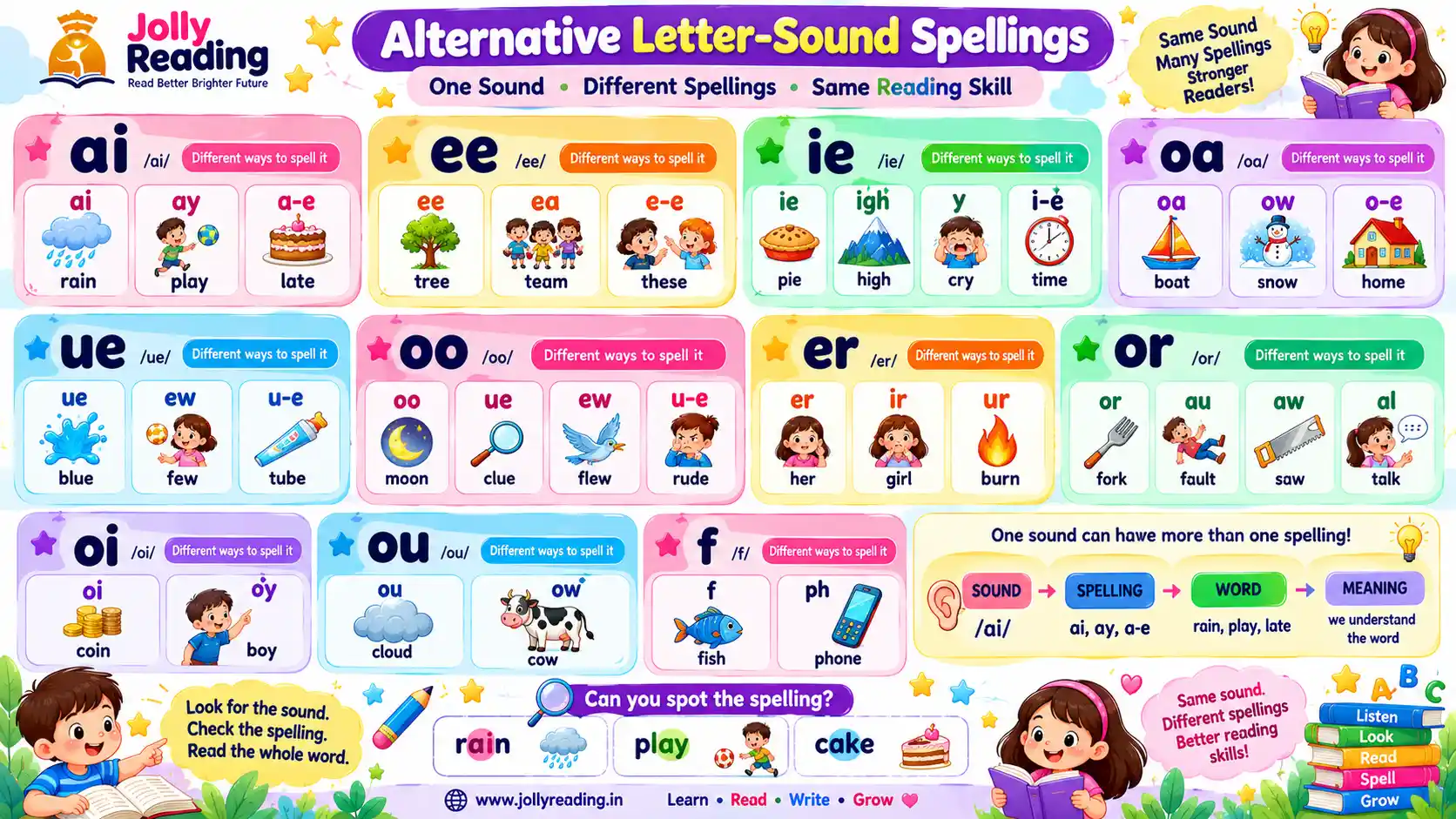
2. The six syllable types
Every English syllable falls into one of six patterns, and the pattern tells you what the vowel says. See the six syllable types.
3. Syllable division
How to split a long word into readable chunks: fan/tas/tic, rab/bit, ti/ger.
4. R-controlled vowels
ar, er, ir, or, ur — the r changes the vowel sound entirely. See r-controlled vowels.
5. The schwa
The lazy "uh" that appears in unstressed syllables, and the main reason older children misspell words like dragon or about. See the schwa sound.
6. Long vowel spelling patterns
Vowel teams and split digraphs, and how to choose between them. See long vowel spelling patterns.
7. Morphology: prefixes, roots and suffixes
Word parts that carry meaning: un-, re-, -ful, -tion. See prefixes and suffixes for kids.
8. Spelling rules
The doubling rule, the drop-e rule and the y-to-i rule, which explain hopping, making and happiness. See spelling rules for kids.
Does Your Child Need Advanced Phonics?
Answer these:
- Do they read short words easily but stumble on long ones?
- Do they read slowly, word by word, and tire quickly?
- Do they guess at longer words from the first syllable?
- Do they spell phonetically but incorrectly: stashun for station?
- Do they miss the middle syllables of words when spelling?
- Do they know the sounds but still fail spelling tests?
Two or more "yes" answers usually mean the gaps are in advanced phonics, not the basics.
The Teaching Order
| Stage | What to teach |
|---|---|
| 1 | Check basics: all 42 sounds, blending, segmenting |
| 2 | Alternative spellings for the vowel sounds |
| 3 | Closed and open syllables, then VCe |
| 4 | Vowel teams and r-controlled syllables |
| 5 | Consonant-le, syllable division of longer words |
| 6 | Schwa, and the effect of stress on spelling |
| 7 | Common prefixes and suffixes, then the three spelling rules |
| 8 | Latin and Greek roots for academic vocabulary |
Why It Matters More After Grade 2
Up to Grade 2, most school reading is short words. From Grade 3, textbooks in science, maths and social studies are full of long words the child has never seen. A child without advanced phonics has only two options: memorise or guess. Neither scales.
This is why children who seemed fine in Grades 1 and 2 often start struggling in Grade 3 or 4.
Advanced Phonics for Older Children
Older children need this taught at their own level, not with material designed for 5-year-olds. Start with a quick check of the basics, fill any gaps fast, then move to syllables and word parts. See phonics for older children aged 7–12.
Classes
Our advanced phonics classes for ages 6–12 cover this full sequence in small live groups, starting with a level check. For the earlier stage, see what is Jolly Phonics and our Jolly Phonics classes.
Frequently Asked Questions
What is advanced phonics? +
Advanced phonics is the stage after the basic letter sounds. It covers alternative spellings, syllable types, syllable division, the schwa, prefixes and suffixes, and spelling rules.
At what age do children learn advanced phonics? +
Usually from around age 6 or 7 onwards, once the basic sounds and blending are secure. Older children with reading gaps also start here after a level check.
What is the difference between basic and advanced phonics? +
Basic phonics teaches one spelling per sound and short words. Advanced phonics teaches the many spellings of each sound and the structure of longer words.
My child reads well but spells badly. Is advanced phonics the answer? +
Often yes. Spelling requires choosing between several possible spellings, which is exactly what advanced phonics teaches.
How long does advanced phonics take? +
It's taught over months rather than weeks, usually alongside school reading. Older children catching up often see clear gains within 8 to 12 weeks.
Is advanced phonics the same as Jolly Phonics Level 2? +
They overlap. Jolly Phonics teacher training Level 2 covers this advanced content for teachers, and our advanced phonics classes teach it to children.