
My Child Knows the Alphabet but Can't Read: Why, and What to Do
Knowing the alphabet and reading are two different skills. The alphabet song teaches a sequence of letter names. Reading needs letter sounds, and the ability to blend those sounds into words. A child can sing A-B-C perfectly and still not know that s makes a hissing sound, or how to turn /c/ /a/ /t/ into cat. This is a gap in what has been taught, not a sign that your child can't learn.
Here is how to find the exact gap and close it.
Table of Contents
The Three Gaps Behind "Knows the Alphabet but Can't Read"
| Gap | What it looks like | What's missing |
|---|---|---|
| 1. Names, not sounds | Says "bee" for b, sings the song fluently, but can't tell you the sound | Letter sounds |
| 2. Sounds out of order only | Knows sounds when singing or in order, but not when you point to a random letter | Instant recognition |
| 3. Sounds but no blending | Says /c/ /a/ /t/ then stops, or guesses a different word | Blending |
Most children who "know the alphabet but can't read" are stuck at gap 1 or 3.
Find the Gap in 5 Minutes
Do this test today. It takes five minutes and tells you exactly where to start.
- Random letter check. Write 10 letters in random order. Point to each and ask for the sound, not the name. A child who is ready to read answers quickly and correctly, every time.
- Pure sound check. Listen to how they say consonants. "Suh" and "buh" instead of /s/ and /b/ will block blending.
- Oral blending check. With no letters at all, say "/d/ /o/ /g/" and ask what word it is. If they can't do this by ear, the problem is blending, not letters.
- Word check. Write sat, pin, hen. Ask them to read each.
Whichever step fails first is where you start.
Why the Alphabet Song Doesn't Lead to Reading
The alphabet song teaches order, the way a nursery rhyme does. It doesn't teach that letters stand for sounds, and letter names actively get in the way: "bee-ay-tee" doesn't sound like bat, but /b/ /a/ /t/ does.
Children often learn the song before school, so parents assume reading will follow. It doesn't, unless someone teaches the sounds and the blending.
What to Do at Each Stage
If the gap is letter sounds
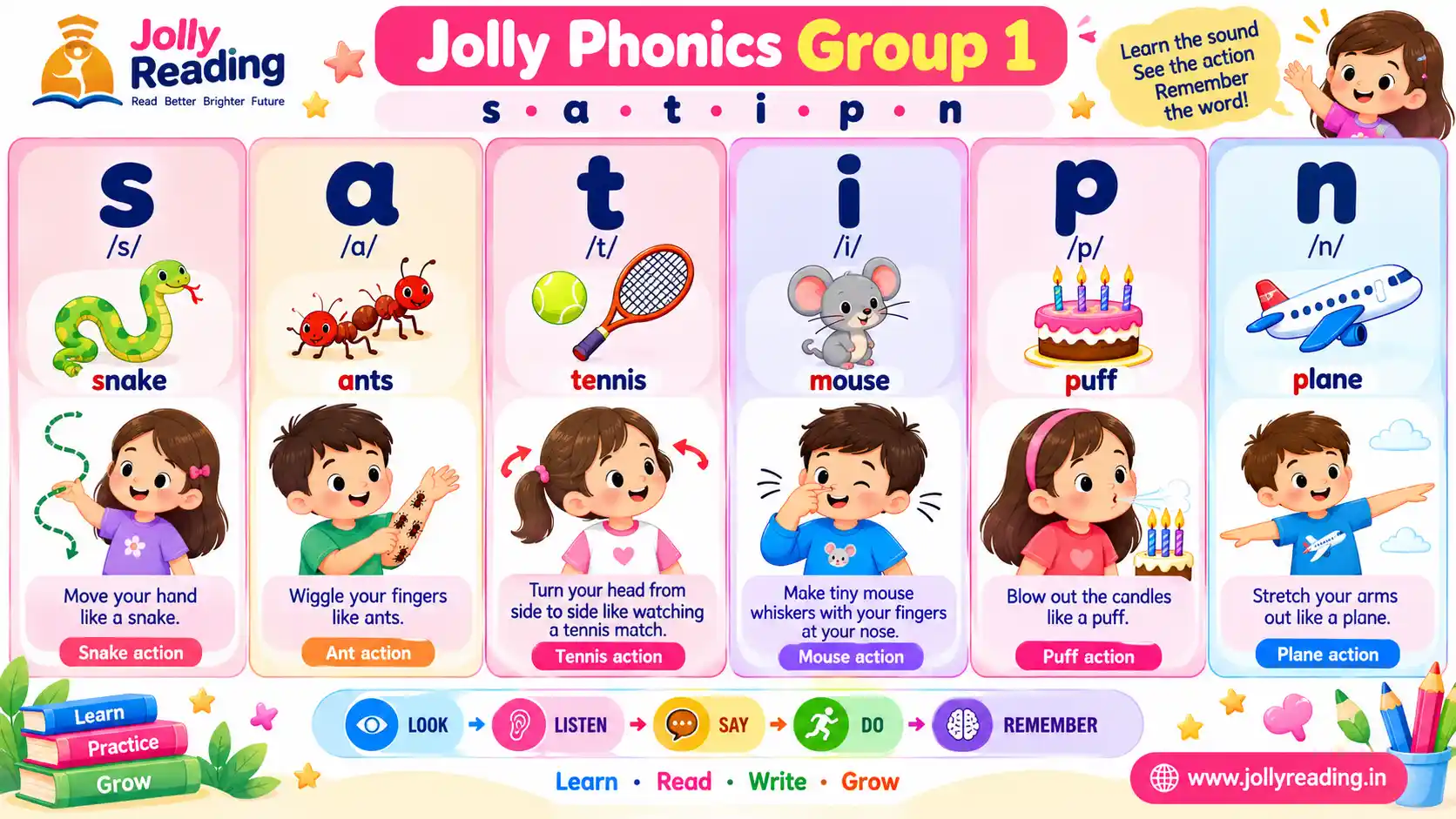
Teach the sounds in phonics order, not A to Z: start with s, a, t, i, p, n, which make many real words. Say pure sounds: /s/ is a hiss, /t/ is short and light. See the 42 sounds of Jolly Phonics.
Do this: one sound a day, two minutes of revision daily, and start building words as soon as you have three or four sounds.
If the gap is instant recognition
Your child knows the sounds but needs a second or two to recall them, which leaves nothing left over for reading the word.
Do this: quick-fire flashcards for two minutes a day, mixing old and new sounds. Aim for an answer within a second.
If the gap is blending
This is the most common stopping point. Blending must be taught, not assumed.
Do this: start with oral blending, no letters. Then two-sound words (at, up), then three. Say the sounds smoothly: "sssuuunnn", not "s… u… n". Full method: how to teach blending.
What Not to Do
| Don't | Why |
|---|---|
| Add more letter-name practice | Names aren't the missing piece |
| Buy word-recognition flashcards | Memorised words don't transfer to new ones, and lead to guessing |
| Wait for it to "click" | Blending rarely appears on its own; it's taught |
| Push harder for longer | Ten focused minutes beats thirty frustrating ones |
| Compare with other children | Children reach these steps at different ages |
How Long Does It Take?
If sounds are known and only blending is missing, many children start reading simple words within 2–6 weeks of daily practice. If sounds have to be retaught, allow 3–4 months to cover the first sound groups with blending along the way. A structured plan is in our guide to teaching phonics at home.
When It Might Be Something More
Most children just need the right teaching. Consider asking your school or a specialist for an assessment if your child is 6 or older and several of these apply:
- Still can't hear rhymes or the first sound in a word
- Struggles to remember letter sounds week after week despite daily practice
- Has trouble remembering names of familiar objects or mixes up similar-sounding words
- There is a family history of reading or spelling difficulty
- Makes reading errors that don't match the letters on the page at all
These are signals to look more closely, not a diagnosis. Reading difficulties, including dyslexia, respond well to structured phonics taught consistently.
A Note for Families Who Speak Another Language at Home
If English is your child's second or third language, the alphabet often gets learned at home or in playgroup while the sounds never do. Two things to check: that your child can hear the English sounds clearly, and that they know the meaning of the words they're blending. See phonics for children learning English as a second language.
Getting Help
If daily practice isn't moving, a structured class usually resets things quickly, because each sound is corrected live. Our small-group online Jolly Phonics classes start with a free demo, where we check exactly which of the three gaps your child is in. Older children who are behind usually need advanced phonics alongside the basics.
Frequently Asked Questions
Why can my child sing the alphabet but not read? +
The alphabet song teaches letter names in order. Reading needs letter sounds and blending, which are separate skills that have to be taught.
Should I teach letter names or letter sounds first? +
Sounds first. Letter names can be taught later, once your child is reading simple words.
My child knows all the sounds but still can't read. Why? +
They most likely can't blend yet. Practise oral blending first, where you say the sounds and they say the word, then move to short written words.
At what age should a child be reading simple words? +
Many children read simple words between 5 and 6, but the range is wide. What matters more is whether the sounds and blending are being taught.
Is it a problem if my child says "buh" instead of /b/? +
Yes, it makes blending much harder. "buh-a-tuh" doesn't sound like bat. Practise short, pure consonant sounds.
Could this be dyslexia? +
It can be, but poor teaching of sounds and blending is far more common. If your child is 6 or over and progress is very slow despite daily structured practice, ask for an assessment.
How long will it take my child to start reading? +
When only blending is missing, many children read simple words within two to six weeks of short daily practice.