
Long Vowel Spelling Patterns: How Children Learn to Choose the Right One
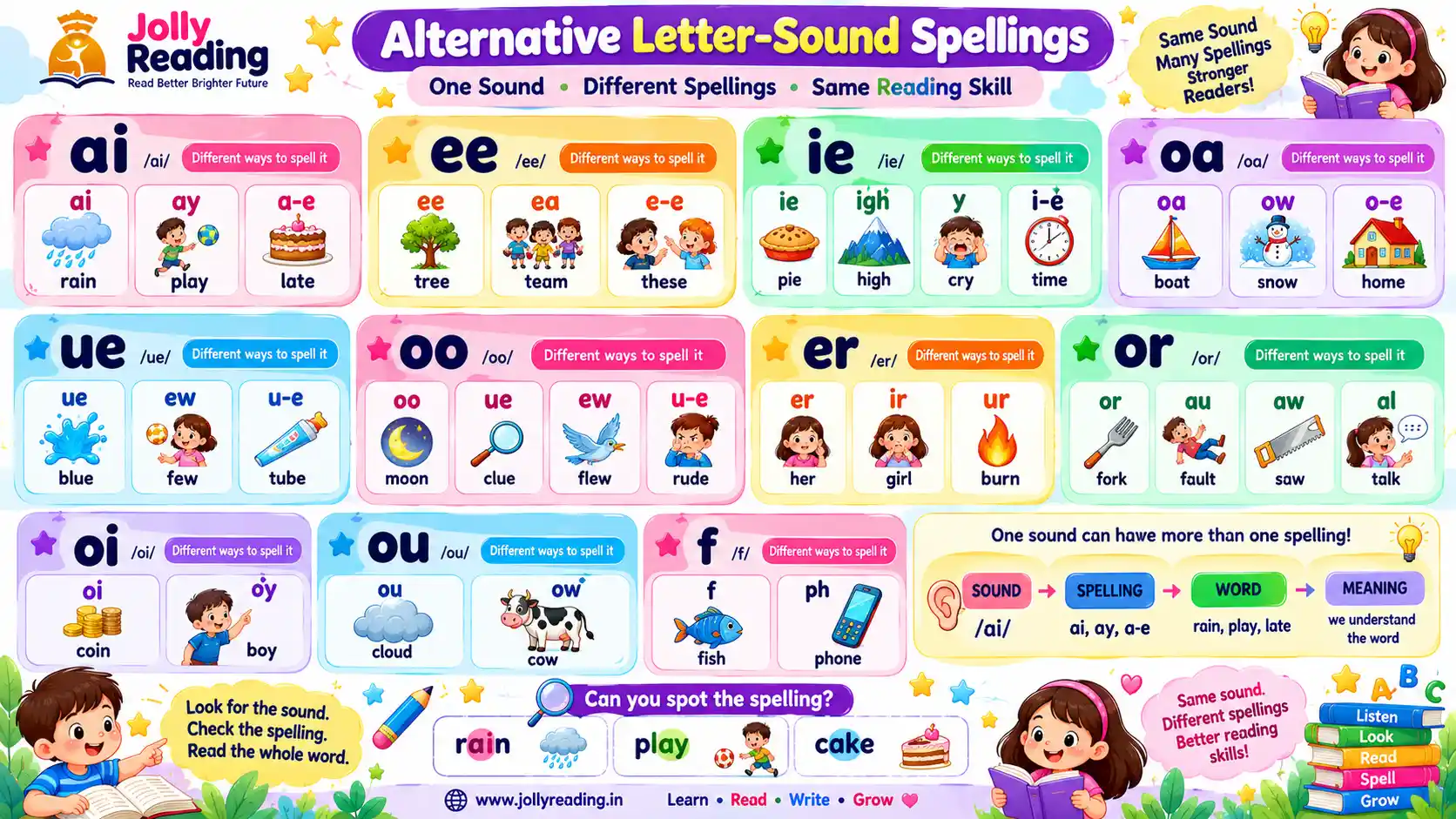
Each long vowel sound has several spellings, and children need to learn which one to use where. The long /a/ sound can be a-e (cake), ai (rain), ay (play) or a alone (apron). Reading these is easy once the patterns are known; choosing the right spelling is the hard part, and it's learned through position patterns, word sorting and dictation.
The Main Long Vowel Spellings
| Sound | Spellings | Examples |
|---|---|---|
| Long a | a-e, ai, ay, a | cake · rain · play · apron |
| Long e | ee, ea, e-e, y, ie | feet · sea · these · happy · chief |
| Long i | i-e, igh, y, ie | time · night · my · pie |
| Long o | o-e, oa, ow, o | bone · boat · snow · open |
| Long u | u-e, ue, ew, u | cube · cue · few · music |
The Position Patterns
These aren't absolute rules, but they hold for most common words and give children a place to start.
| Pattern | Examples |
|---|---|
| ay and ow usually come at the end of a word | play, day · snow, grow |
| ai and oa usually come in the middle | rain, train · boat, coat |
| igh usually comes before t | night, light, fight |
| y says long i at the end of short words | my, by, cry, fly |
| y says long e at the end of longer words | happy, sunny, family |
| Split digraphs (a-e, i-e, o-e, u-e) sit inside the word | cake, time, bone, cube |
| A single vowel at the end of an open syllable is long | he, go, o/pen, ti/ger |
Split Digraphs, or "Magic E"
In cake, the a and the silent e work together to make the long sound, with a consonant between them. Children find this easier once they've seen the flip:
rid → ride · hop → hope · tub → tube · can → cane
Read both words, then have your child do the flipping. This shows that the e is doing a job, not just sitting there.
Vowel Teams That Aren't Always Long
Two traps worth teaching directly:
- ea says long e in sea, but short e in head, bread, ready.
- ow says long o in snow, but /ou/ in cow, down.
Teach the try-both strategy: try the first sound; if it isn't a real word, try the other. "C-ow… is that 'coe'? No. Cow."
How to Teach Choice, Not Just Recognition
- One sound family at a time. A week on long a: a-e, ai, ay.
- Sort words. Give 15 long-a words and let your child sort them by spelling. The patterns emerge from the sorting.
- Dictate from one family. play, rain, cake, stay, train. Children have to choose, which is the real skill.
- Use the position rules as prompts: "Is the sound at the end of the word? Which spelling likes the end?"
- Keep a chart. One column per spelling, add new words as they appear in reading.
- Leave exceptions for later. Said, have and great break patterns; teach them as tricky words rather than rules.
Reading Before Spelling
Children read all of these correctly long before they can spell them. That's normal and not a problem: recognising a spelling is easier than choosing one. Keep reading practice ahead of spelling expectations.
Where This Fits
Long vowel patterns overlap with alternative spellings and the vowel team and VCe syllable types. All of it sits inside advanced phonics, which children work through in our advanced phonics classes for ages 6–12.
Frequently Asked Questions
What are long vowel spelling patterns? +
They're the different ways each long vowel sound can be written, such as a-e, ai and ay for the long a sound.
What is a split digraph? +
Two letters that make one vowel sound but are separated by a consonant, such as a-e in cake. It's also called magic e.
When do you use ai and when ay? +
ai usually comes in the middle of a word (rain), and ay at the end (play).
Why does ea sometimes say a short sound? +
ea is a vowel team with more than one job: long e in sea, short e in head. Children learn to try both sounds.
How do I help my child choose the right spelling? +
Teach one sound family at a time, sort words by spelling pattern, and use dictation so your child has to make the choice.
When are long vowel patterns taught? +
After short vowels and the basic sounds, usually in the second year of phonics and continuing into later primary.
Why can my child read these words but not spell them? +
Reading needs recognition; spelling needs choice between several possible spellings. Choice takes longer and needs dictation practice.